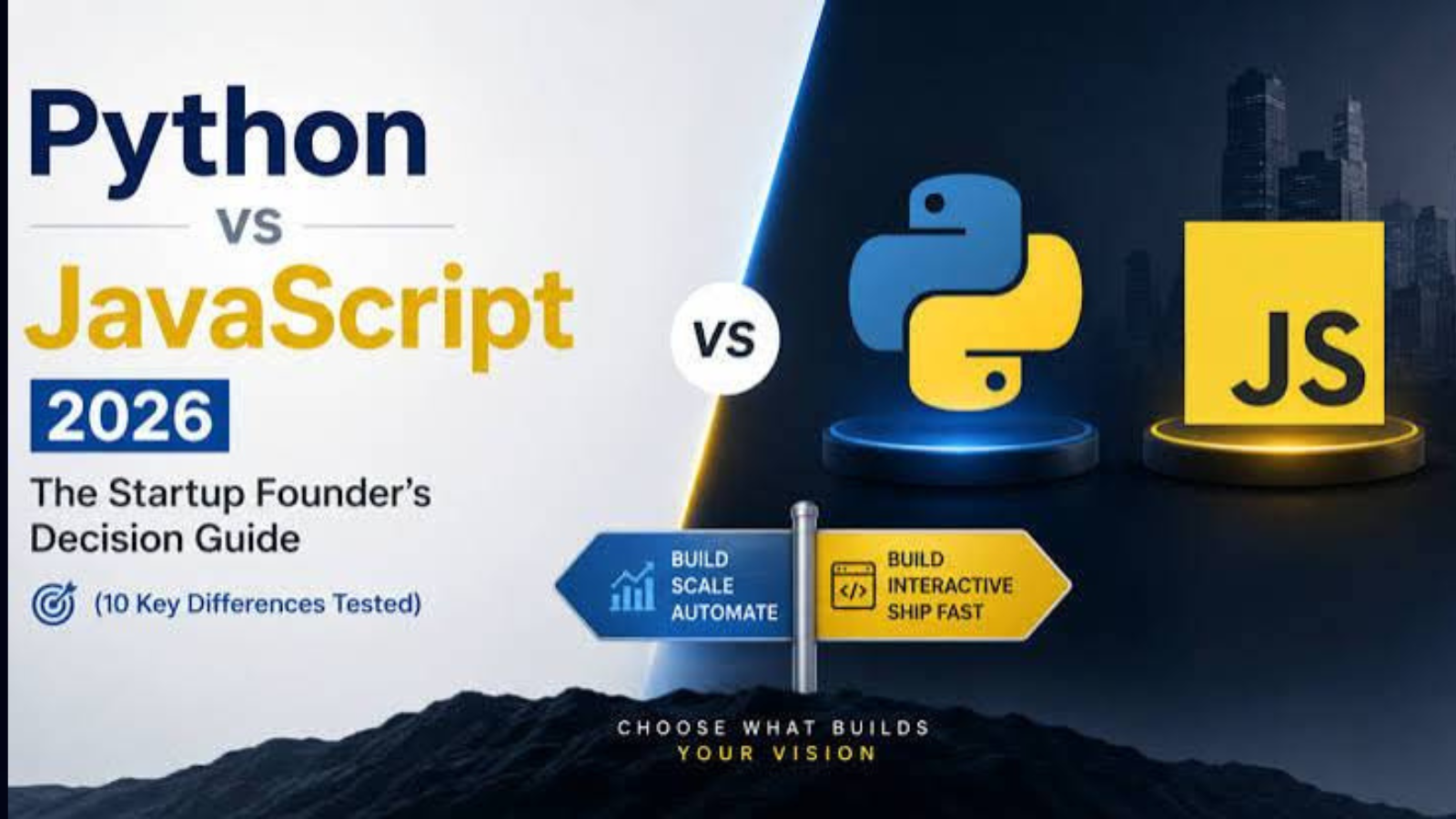
: The answer depends on your goal. Learn JavaScript if you want to build websites or web apps. Learn Python if you’re heading into data science, AI, or automation. Both languages are beginner-friendly, but each serves a distinct career path — and picking the wrong one first costs you time.
Two languages dominate nearly every “best programming languages to learn” list: JavaScript and Python. Both are beginner-friendly. Both are in high demand. Both power some of the world’s most-used software. So when someone asks “should I learn JavaScript or Python?”, the honest answer isn’t a single name — it’s a question back: what do you actually want to build?
This guide cuts through the noise. You’ll get a clear JavaScript vs Python breakdown, a direct comparison of use cases, beginner-specific advice for 2026, and a decision framework that maps to your actual goals — whether that’s landing your first dev job, breaking into data science, building a web app, or just learning to code for the first time.
No filler. No hedging. Here’s what you need to know.
[Suggested image placement: Side-by-side logo comparison of JavaScript and Python on a dark background. Alt text: “JavaScript logo versus Python logo side by side.” Caption: “JavaScript and Python are the two most popular first languages in 2026 — but they serve very different purposes.”]
JavaScript vs Python: What Are They, and What Do They Do?
Before comparing them, understand what each language is actually built for.
JavaScript was created in 1995 to make web pages interactive. Today, JavaScript runs in every major browser and powers the front-end of virtually every website you use. With the introduction of Node.js, JavaScript also runs on servers — making it a full-stack language capable of handling both client-side and server-side development.
Python was created in 1991 with a focus on readability and simplicity. Python does not run natively in browsers, but it excels in environments where data processing, automation, and scientific computing matter. Python has become the dominant language in data science, machine learning, and artificial intelligence — largely because of libraries like NumPy, Pandas, TensorFlow, and scikit-learn.
Both languages consistently rank in the top three of the Stack Overflow Developer Survey, which polls over 90,000 developers annually. In the 2024 edition, JavaScript held its position as the most-used language for the twelfth consecutive year, while Python ranked third overall and first among those learning to code.
They are different tools. Choosing between them is not about which is “better” — it is about which fits your destination.
Python vs JavaScript for Beginners in 2026: Which Is Easier to Learn?
This is the most common version of the question, and the answer leans toward Python.
Python’s syntax is designed to resemble plain English. Variable declarations, loops, and functions read more naturally than in almost any other language. There are no curly braces to close, no semicolons to remember, and fewer opportunities to introduce subtle formatting bugs that confuse new learners.
Compare a basic function in each language:
Python:
def greet(name): return f”Hello, {name}!”
JavaScript:
function greet(name) { return `Hello, ${name}!`;}
Both are simple. But Python’s indentation-based structure forces clean formatting by default — a significant advantage when you are still building habits. JavaScript gives you more freedom, which translates to more ways to write confusing code before you understand why certain patterns cause problems.
That said, “easier to learn” and “easier to get a result you can show someone” are different things. If you want to build something visible in a browser within your first week, JavaScript gets you there faster. Python outputs to a terminal by default — useful for logic and computation, but less immediately satisfying if your goal is a working web page.
The practical summary:
- Python is easier to read and write as a first language.
- JavaScript produces visible browser-based results faster.
- Python teaches programming fundamentals more cleanly.
- JavaScript teaches web development concepts alongside programming concepts — which is either an advantage or an overhead, depending on your patience.
[Suggested image placement: A screenshot of Python code and JavaScript code side by side, both producing the same output. Alt text: “Python and JavaScript code comparison showing the same function written in each language.” Caption: “Python’s syntax is more readable for beginners — but JavaScript delivers results you can see in a browser immediately.”]
Key Differences: JavaScript and Python Use Cases
The clearest way to choose between these languages is to map them against real-world applications. Here is where each language dominates.
What Can You Build With JavaScript?
- Front-end web development: Every interactive element on a website — menus, forms, animations, real-time updates — runs on JavaScript. Frameworks like React, Vue, and Angular are all JavaScript-based.
- Back-end web development: Node.js brings JavaScript to the server side. Platforms like LinkedIn, Netflix, and Uber use Node.js to handle millions of concurrent requests.
- Mobile apps: React Native lets you build iOS and Android apps using JavaScript.
- Browser extensions and tools: Chrome extensions are written in JavaScript.
- Real-time applications: Chat apps, collaborative tools, and live dashboards benefit from JavaScript’s event-driven, non-blocking architecture.
What Can You Build With Python?
- Data analysis and visualization: Python’s Pandas and Matplotlib libraries are the industry standard for analyzing and plotting data.
- Machine learning and AI: TensorFlow, PyTorch, and scikit-learn are Python-based. Most AI research and production ML pipelines are built in Python.
- Automation and scripting: Python scripts automate repetitive tasks — file management, web scraping, report generation — with minimal code.
- Backend web development: Frameworks like Django and Flask make Python viable for web backends, though it is less common than JavaScript for this purpose.
- Scientific computing: Python is used extensively in biology, physics, finance, and engineering for numerical computation and simulation.
The overlap exists — both languages can build backends, and Python has web frameworks. But the dominant use cases are distinct. JavaScript owns the browser and web interactivity. Python owns data, automation, and AI.
Should You Learn Python or JavaScript First? A Goal-Based Decision
Stop asking which language is objectively better. Ask which one connects directly to what you want to do in the next 12 months.
| Your Goal | Learn This First |
| Build websites or web apps | JavaScript |
| Get a front-end developer job | JavaScript |
| Work in data science or analytics | Python |
| Pursue machine learning or AI | Python |
| Automate tasks and write scripts | Python |
| Build mobile apps | JavaScript (React Native) |
| Get into backend development | Either (JavaScript via Node.js, Python via Django/Flask) |
| Learn programming fundamentals | Python |
| Break into cybersecurity | Python |
| Build browser-based games or tools | JavaScript |
If your goal is a front-end developer role, JavaScript is not optional — it is the job. Every front-end developer writes JavaScript daily. Starting with Python first would add six to twelve months before you could pivot back to the skills employers actually screen for in that role.
If your goal is data science, the situation is reversed. Python for JavaScript developers exists as a common transition path — many JavaScript developers learn Python later to expand into data work — but starting with Python saves you that detour.
If you have no specific goal yet and simply want to understand how programming works, Python gives you a cleaner foundation. The language structure teaches logic, functions, and data structures without layering in browser-specific behavior at the same time.
Python and JavaScript: Can You Learn Both?
Yes — and many developers do. The more relevant question is sequencing.
Learning both languages simultaneously as a beginner is rarely efficient. Your time splits, your fundamentals stay shallow in both, and the syntactic differences create persistent confusion. The standard recommendation is to reach a solid intermediate level in one language before introducing the second. That typically means six to twelve months of focused work.
Once you have strong foundations in one language, picking up a second becomes significantly faster. Python and JavaScript share core programming concepts — variables, functions, loops, conditionals, data structures, and object-oriented patterns — even if the syntax differs. A developer who knows Python well can read JavaScript code with reasonable comprehension within weeks.
Python for JavaScript developers is a well-established transition path. JavaScript developers moving into data science or ML work learn Python specifically for those applications — not as a replacement for JavaScript, but as a second tool for a different job. The reverse is equally common: Python developers who want to add web front-end skills learn JavaScript as their second language.
The sequencing rule: Pick one, go deep, then add the second when your first is solid.
[Suggested image placement: A roadmap-style graphic showing a learning path — JavaScript to React for web dev, Python to Pandas/TensorFlow for data/AI. Alt text: “Learning roadmap comparing JavaScript web development path and Python data science path.” Caption: “Both paths lead to strong career outcomes — the choice is about direction, not difficulty.”]
Which Language Is Better for Your Goals? Specific Scenarios
Python vs JavaScript for Data Science
Python wins, clearly. The data science ecosystem — Pandas, NumPy, Jupyter Notebooks, scikit-learn, TensorFlow, PyTorch — is built in and for Python. JavaScript has data visualization libraries like D3.js, but they are used for displaying data in browsers, not for analysis or modeling. If your goal is data science, starting with JavaScript adds unnecessary detour time.
Python vs JavaScript for Web Development
JavaScript wins for front-end development — there is no browser-native alternative. For back-end web development, both are viable. Node.js (JavaScript) handles high-concurrency real-time applications well. Django and Flask (Python) are strong choices for data-heavy or API-focused backends. If you want to build full-stack web applications with a single language, JavaScript gives you that option via Node.js.
Python vs JavaScript for AI and Machine Learning
Python is the industry standard. The major AI frameworks — TensorFlow, PyTorch, Hugging Face — all have Python as their primary interface. Research papers publish Python code. ML job listings specify Python. There is no realistic path to working in AI/ML without Python proficiency.
Python vs JavaScript for Automation
Python is the stronger choice. Its straightforward syntax and rich standard library make it fast to write automation scripts. Tools like Selenium (web automation), Beautiful Soup (web scraping), and Paramiko (server automation) are Python-native. JavaScript can automate browser tasks via tools like Puppeteer, but Python covers a broader automation landscape.
Python vs JavaScript for Beginners with No Specific Goal
Start with Python. It teaches programming fundamentals cleanly, has a supportive beginner community, and opens doors to high-demand fields like data science and AI. You can always add JavaScript later when you have a concrete reason to build for the web.
Make Your Choice and Move Forward
The JavaScript vs Python debate has a practical answer for each person — it just varies by person.
- You want to build for the web: JavaScript.
- You want to work with data, ML, or AI: Python.
- You want the cleaner first language: Python.
- You want visible browser results fast: JavaScript.
- You want the most career versatility long-term: Learn both, in sequence.
The worst decision is spending months comparing the two instead of committing to one. Both languages have massive job markets, strong communities, and extensive free learning resources. Pick the one that aligns with your actual goal, start today, and revisit the other language in twelve months when your fundamentals are solid.
For more on the tools and technologies shaping development in 2026, explore Jaytechdigital’s coverage of AI developments and the latest apps and developer tools.
Frequently Asked Questions: JavaScript vs Python
Should I learn JavaScript or Python first as a complete beginner?
Learn Python first if you have no specific project in mind. Python’s syntax is closer to plain English, it teaches programming logic cleanly, and it opens doors to data science and AI. Learn JavaScript first if your immediate goal is to build websites or land a front-end developer job.
Is Python harder than JavaScript to learn?
Python is generally considered easier for beginners. Its indentation-based syntax enforces clean code habits and removes several sources of confusion common in JavaScript, such as variable scoping, the this keyword, and asynchronous behavior. JavaScript introduces more complexity earlier because it is tied to browser behavior.
Can I use Python and JavaScript together in the same project?
Yes. Many full-stack applications use Python (via Django or Flask) as the back-end API layer and JavaScript (via React or Vue) as the front-end. The two languages communicate via HTTP requests. You do not have to choose one exclusively — most professional developers use both in their day-to-day work.
Which language pays more — Python or JavaScript developers?
Salaries depend on role, location, and experience level more than language. According to the Stack Overflow Developer Survey 2024, both Python and JavaScript developers earn competitive salaries globally. Python developers in data science and ML roles often command higher salaries due to the specialized skill set required. JavaScript front-end developers have a larger job market and more entry-level opportunities.
How long does it take to learn JavaScript or Python?
Reaching a beginner-to-intermediate level takes approximately three to six months of consistent daily practice (one to two hours per day). Reaching job-ready proficiency — where you can build projects independently and pass technical interviews — typically takes six to twelve months for either language, depending on your pace and the complexity of the role you are targeting.
Is JavaScript or Python better for freelancing?
JavaScript offers more freelance opportunities in web development, which is the largest category of freelance tech work. Python is in demand for data analysis, automation, and AI freelance work. JavaScript has a higher volume of projects; Python projects often pay more per hour due to specialization.
Which language should I learn if I want to get into AI in 2026?
Learn Python. The AI and machine learning ecosystem — including TensorFlow, PyTorch, Hugging Face, and most published research code — runs on Python. There is no practical alternative for serious AI work as of 2026.