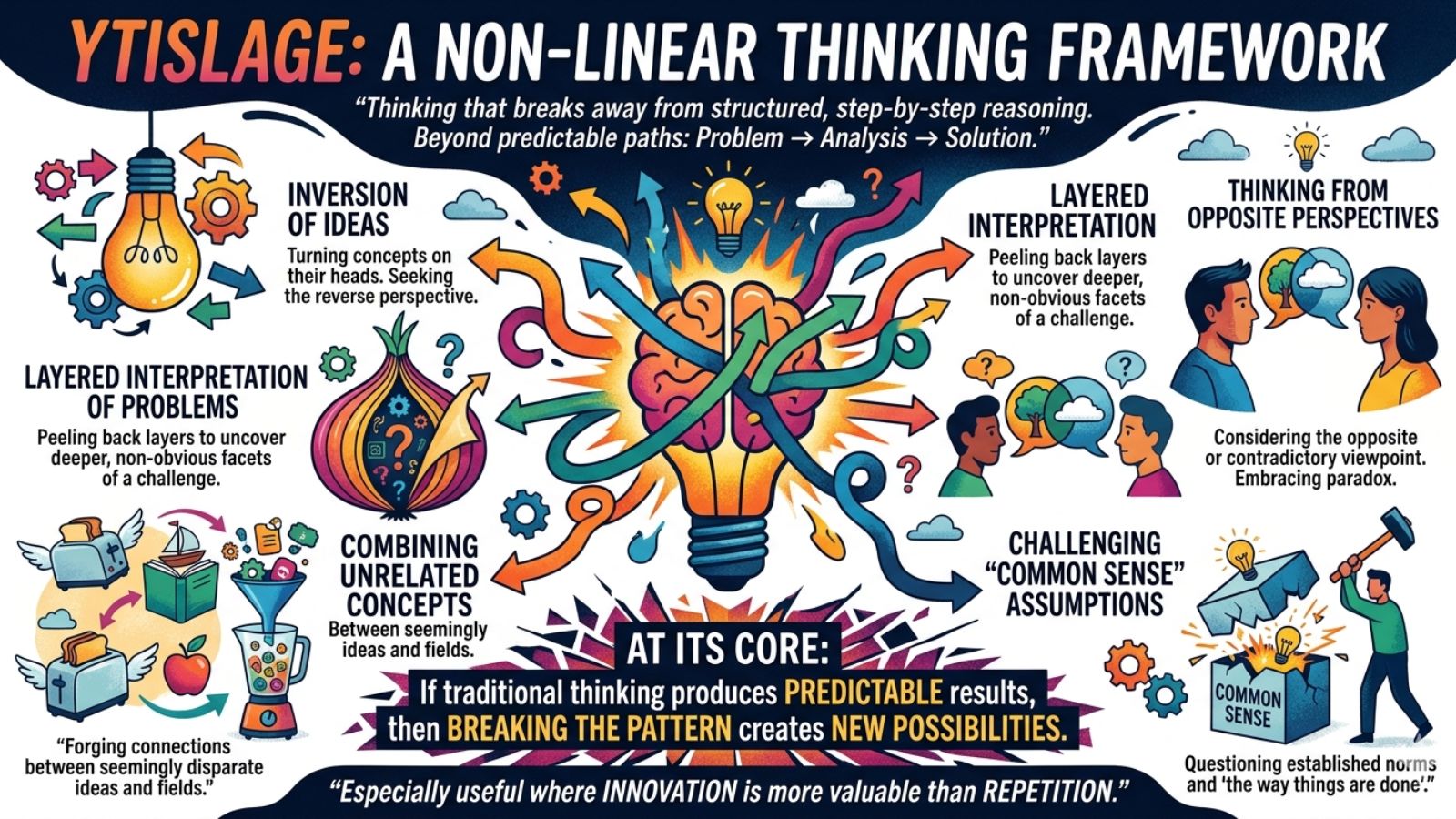
Ytislage – In a world where most systems, education models, and problem-solving methods still rely on linear thinking, a new conceptual framework called ytislage is gaining attention in creative and innovation-driven communities. It is described as a mindset approach that challenges traditional logic, encourages inverted reasoning, and pushes individuals to explore ideas beyond standard cognitive boundaries.
While ytislage is not tied to a formal academic theory, it represents a growing shift in how people think about creativity, innovation, and problem-solving in the modern world. The core idea is simple: traditional thinking rules are no longer enough to solve modern, complex problems.
This article explores what ytislage means, why it matters, how it works, and how it is influencing creative thinkers, professionals, and innovators.
What Is Ytislage?
Ytislage can be understood as a non-linear thinking framework that breaks away from structured, step-by-step reasoning. Instead of following predictable paths (problem → analysis → solution), ytislage encourages:
- Inversion of ideas
- Layered interpretation of problems
- Thinking from opposite perspectives
- Combining unrelated concepts
- Challenging “common sense” assumptions
At its core, ytislage promotes one key principle:
If traditional thinking produces predictable results, then breaking the pattern creates new possibilities.
Also Read: Tracqueur Technology: Ultimate Tracking System Guide
This approach is especially useful in environments where innovation is more valuable than repetition.
Why Ytislage Is Breaking Traditional Thinking Rules
Traditional thinking systems are built on logic, structure, and repetition. These systems work well in stable environments, but they often fail in fast-changing, complex situations.
Ytislage breaks these rules in several important ways:
1. It Rejects Linear Thinking
Most traditional frameworks rely on step-by-step logic. Ytislage instead encourages jumping across ideas, exploring unexpected links, and thinking in loops rather than straight lines.
This helps uncover solutions that are not visible through structured analysis.
2. It Encourages Inverted Problem Solving
Instead of asking, “How do we solve this problem?” ytislage asks:
- “What if we approach it from the opposite direction?”
- “What would make this problem worse?”
- “What if the solution is the reverse of what we assume?”
This inversion technique often reveals hidden insights.
3. It Breaks Category Boundaries
Traditional thinking separates fields—business, art, science, education. Ytislage encourages cross-category thinking, where ideas from one domain are applied to another.
For example:
- Music structure used in business strategy
- Biological systems applied to software design
- Art principles used in engineering innovation
4. It Removes Cognitive Limitations
People often unconsciously limit themselves with assumptions like:
- “That won’t work in my field”
- “This is how it has always been done”
- “There is only one correct solution”
Ytislage challenges these mental blocks and promotes open-ended thinking.
The Core Principles of Ytislage
To understand ytislage deeply, it helps to break it down into its core principles:
1. Non-Linearity
Ideas do not need to follow a straight path. They can move freely across different directions.
2. Reversal Thinking
Every idea can be flipped to reveal a new perspective.
3. Layered Interpretation
Problems can have multiple hidden layers, not just surface-level meaning.
4. Concept Blending
Combining unrelated ideas can produce unexpected innovation.
5. Rule Flexibility
Rules are not fixed; they are tools that can be adapted or temporarily ignored.
How Ytislage Works in Real Life
Although ytislage is a conceptual framework, it can be applied in various real-world scenarios.
In Creativity and Art
Artists use ytislage-like thinking by breaking traditional composition rules, mixing styles, or reversing expected visual patterns.
In Business
Entrepreneurs apply similar thinking when they:
- Disrupt existing industries
- Reimagine customer experience
- Combine unrelated markets
In Education
Educators can use ytislage principles by encouraging students to:
- Question standard answers
- Explore multiple solutions
- Think beyond textbook definitions
In Technology
Developers and engineers use non-linear thinking when designing innovative systems that do not follow traditional structures.
Benefits of Ytislage Thinking
Adopting ytislage-style thinking can lead to several advantages:
1. Enhanced Creativity
It helps generate original ideas instead of repetitive solutions.
2. Better Problem Solving
By breaking assumptions, hidden solutions become visible.
3. Increased Adaptability
People become more flexible in uncertain environments.
4. Stronger Innovation Skills
It encourages experimentation and risk-taking in thinking.
5. Improved Perspective Awareness
Individuals learn to see problems from multiple angles.
Challenges of Ytislage Thinking
Despite its advantages, ytislage also comes with challenges:
1. Lack of Structure
Some people may find it difficult to operate without clear rules.
2. Over-Complexity
Too many perspectives can lead to confusion.
3. Resistance to Change
Traditional thinkers may resist non-linear methods.
4. Misinterpretation
Without balance, it can be misunderstood as chaotic thinking.
The key is not to abandon logic completely but to expand beyond it.
Why Ytislage Matters in 2026
Modern problems are more complex than ever. Technology, culture, and business environments change rapidly. Linear thinking alone cannot keep up.
Ytislage represents a shift toward:
- Flexible intelligence
- Adaptive creativity
- Multi-dimensional thinking
- Cross-disciplinary innovation
In a sense, it reflects how modern minds must operate: not in straight lines, but in networks of ideas.
Final Thoughts
Ytislage is more than just a concept—it is a mindset shift. By breaking traditional thinking rules, it opens the door to creativity, innovation, and deeper problem-solving abilities.
While it may not replace structured logic, it works best when combined with it. The real power lies in balancing order and chaos, structure and freedom, logic and imagination.
In a world that rewards originality and fast adaptation, ytislage-style thinking may become one of the most valuable cognitive tools of the future.
FAQs About Ytislage
1. What is ytislage in simple terms?
Ytislage is a thinking approach that breaks traditional logic and encourages non-linear, creative, and reversed problem-solving methods.
2. Is ytislage a scientific theory?
No, ytislage is a conceptual or philosophical framework used to describe creative and unconventional thinking patterns.
3. How does ytislage help in creativity?
It helps by removing mental limitations, encouraging idea mixing, and allowing people to see problems from multiple perspectives.
4. Can ytislage be used in business?
Yes, it can help businesses innovate, solve problems differently, and develop unique strategies by challenging traditional methods.
5. Is ytislage difficult to learn?
It is not difficult, but it requires practice to break old thinking habits and adopt more flexible, open-ended reasoning.